
News & Awards
Awards
Finalist for 2018 BC Premier’s Award
The Bralorne-Takla Mine site was a finalist for this award to BC government projects, to recognize important contributions. Azimuth supported BC’s Crown Contaminated Sites Program (now in BC Ministry of Forests) in risk assessment and management of this remote orphaned mercury mine site.
2017 Brownie Award Canadian Brownsfield Network
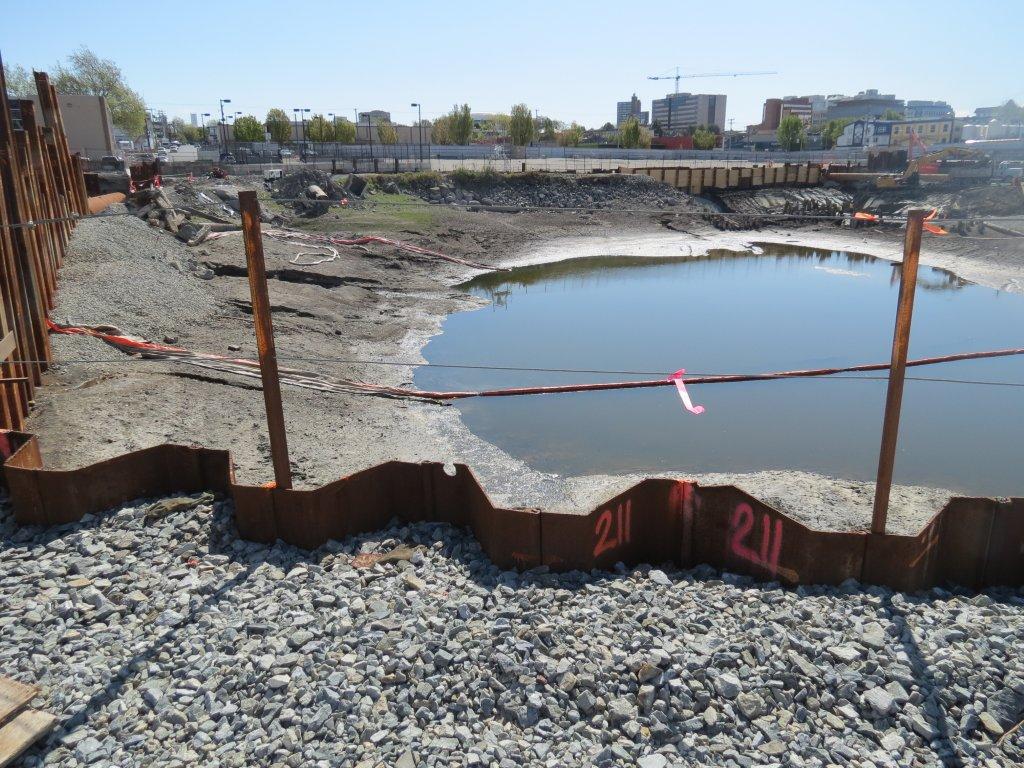
The BC Hydro Rock Bay project was awarded the Brownie Award in Category 2: Remediate – Sustainable Remediation and Technological Innovation. Rock Bay is a complex and urban contaminated site in Victoria, BC. As Risk Assessment Lead, Beth Power of Azimuth supported SNC-Lavalin (prime contractor) to navigate the data needs and regulatory requirements, resulting in parcel-by-parcel risk assessments that secured a number of Certificates of Compliance.
2014 Robert E Leckie Award for Excellence in Environmental Stewardship – Quartz Mining
The Sä Dena Hes Mine was the first mine to be voluntarily closed in the Yukon and this project received the 2014 award for excellence in environmental stewardship from the Yukon Territory government (Yukon Energy Mines and Resource). Azimuth played a key role in this project by evaluating ecological and human health risks to contribute to remediation planning and mine closure.

2012 Jake McDonald Reclamation Award
The Pinchi Mine reclamation received this award in 2012, which is awarded by the BC Technical and Research Committee on Reclamation to recognize outstanding achievement in mine reclamation in BC. Azimuth contributed by evaluating post-reclamation risks to ecological receptors and advising on risk management and monitoring. As well, the project was awarded the 2014 Tony Milligan Book Award at the BC Technical & Research Committee on Reclamation Symposium.

Presentations
Meara Crawford – “Compilation and Evaluation of Fish specific Toxicity Reference Values (TRVs)“
For the Federal Contaminated Sites Action Plan (FCSAP)
Alena Fikart – “30 Years of Risk Assessment in BC. Looking Forward, Looking Backward.”
Azimuth Staff Publish in BC’s College of Applied Biologist ‘College Matters’ Newsletter
Practice of Biology Applied to Ecological Risk Assessment of Chemical Stressors.

Select Publications from Our Scientists
Allard P, Fairbrother A, Hope BK, Hull RN, Johnson MS, Kapustka L, Mann G, McDonald B, Sample BE. 2010. Recommendations for the development and application of wildlife toxicity reference values. Integr Environ Assess Manag 6: 28– 37.
Johnson MS, Beking M, Verbruggen EMJ, McVey EA, Power BA, Kilgour C, Bean TG, Moore DRJ, Greenberg MS, Burris J, Charter D. 2024. Using emerging science to inform risk characterizations for wildlife within current regulatory frameworks. Integr Environ Assess Manag. 20(3):765-779.
Healey N. 2009. Lead toxicity, vulnerable subpopulations and emergency preparedness. Radiation Protection Dosimetry 134(3-4): 143-151.
Hill RA, Pyper BJ, Lawrence GS, Mann GS, Allard P, Mackintosh C, Healey N, Dwyer J, Trowell J. 2013. Using sparse dose-response data for wildlife risk assessment. Integr Environ Assess Manag. 10(1): 3-11.
Hill RA. 2005. Conceptualizing risk assessment methodology for genetically modified organisms. Environmental Biosafety Research. 4(2): 67-70.
Hill RA. and C. Sendashonga. 2003. General Principles for Risk Assessment of Living Modified Organisms: Lessons from Chemical Risk Assessment. Environmental Biosafety Research. 2: 81-88.
Mackintosh CE, Maldonado J, Hongwu J, Hoover N, Chong A, Ikonomou MG, Gobas FAPC. 2004. The Distribution of Phthalate Esters in a Marine Aquatic Food Web: Comparison to PCBs. Environmental Science and Technology. 38(7): 2011-2020.
Mackintosh CE, Maldonado JA, Ikonomou MG, Gobas FAPC. 2006. Sorption of Phthalate Esters and PCBs in a Marine Ecosystem. Environmental Science and Technology. 40(11): 3481-3488.
Power EA and Boumphrey RS. 2004. International trends in bioassay use for effluent management. Ecotoxicology. 13:377-398.
Power BA, Tinholt MJ, Hill RA, Fikart A, Wilson RM, Stewart GG, Sinnett GG, Runnells JL. 2010. A risk-ranking methodology for prioritizing historic, potentially contaminated mine sites in British Columbia. Integr Environ Assess Manag. 6(1): 1-10.
Sample B, Johnson MS, Hull RN, Kaputska L, Landis G, Murphy CA, Sorensen M, Mann G, Gust KA, Mayfield DB, Ludwigs J, Munns WR. 2022. Key challenges and developments in wildlife ecological risk assessment: Problem formulation. Integr Environ Assess Manag. 20(3):658-673.
van den Brink NW, Elliot JE, Power B, Kilgour C, Johnson MS. 2024. Key challenges and developments in wildlife ecological risk assessment: Integrating emerging science to improve estimates of risk to wildlife from chemical exposure: What are the challenges? Integr Environ Assess Manag. 20(3):645-657.
Hill R, B Pyper & S Engelking. 2025. Multi-level modeling of concentration-response data can improve risk assessment: a case study of copper effects on fish. Integr Environ Assess Manag. vjaf138.
News & Updates
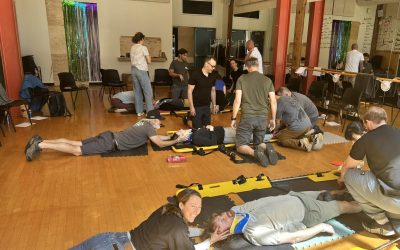
Azimuth Health & Safety Day 2026
Annually, we gather and spend a day together to focus on Azimuth’s Occupational Health & Safety Program. This year, we hired Alert First Aid to provide WorkSafeBC’s Transportation Endorsement training. This better equips our team to safely work in areas that may...

Copper Effects on Fish – New Publication
Azimuth staff authored a recent paper on copper – where we leveraged a large dataset on copper toxicity to rainbow trout to improve site-specific estimates of risk. Citation here: Multilevel modeling of concentration-response data can improve risk assessment: a case...

Avetta Safety Star
We’re honoured to receive recognition from @Avetta as a 2025 Safety Star recipient, celebrating our perfect year-over-year safety performance score. Maintaining rigorous safety standards is fundamental to Azimuth—ensuring every worker returns home safely each day....